Marek Dabrowski
Through the ages China has appeared to the Western World as mysterious. Outsiders have always been fascinated by China’s culture, people, philosophy and natural environment. Attracted by its beauty, they have tried to reveal its deepest secrets and, in fact, made many interesting discoveries. Then, for a while it seemed that time stopped. The Communist system kept foreigners away from China’s political, religious and cultural affairs. The last decade, of course, has been marked by great social, political and economic developments, so much so that now it is impossible to keep up with the country’s transformation.
World-wide media successfully advertise this progress by broadcasting scenes and views of prosperous districts in Beijing, Shanghai, Tianjin or Hong Kong. Also picturesque sights of nature, tourist attractions and small miracles of fauna and flora find their way to international viewers. Yet very seldom does one see reports on people or places in China which are far from the mainstream of these remarkable changes.
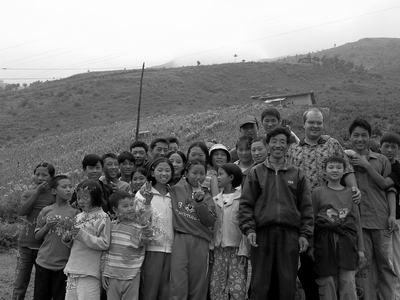
In this article I would like to share an experience from my recent visit to China. It is of one of these out of the way places, quite different from the image popularly projected by the media.
I visited a village in the southwestern part of China, in Sichuan Province. Yuexi where I stayed for a month - is surrounded by beautiful mountains. In those mountains there are seventeen settlements inhabited by lepers. Yuexi Village is one of the biggest of them with a population of one thousand indigenous people. The purpose of the visit was to help the local community take care of the education of the children. I was very surprised to find out that meeting such a basic need as an elementary education was a big problem in that area. But, in fact, it is. The schools are far away and children from leper families are not always welcome when they get to these schools. Thanks however to the efforts of Vickie Chuan, a Taiwanese volunteer who invited me for the summer project, a group of kids have been able to enjoy the benefits of learning for the past four years.
One day a girl approached me and said that Vickie Chuan was a blessing for them, since without her she and many other kids could not speak Chinese and would not be able to communicate freely with other Chinese citizens. Most of the people there speak only their native dialect. After I got to know Vickie better, I realized how talented a leader she was, well-informed, self-disciplined, well-organized and totally devoted to the local community. She and an organization Vickie cooperates with were the first group of people who noticed the great need of children from leper families for elementary education.
When I arrived at the village I found a small school built by Vickie and other sponsors from Taiwan. It was just finished. A dormitory for young students was also ready to be opened. Thirty children from a remote mountain area - it took some 12 hours by car to get there - were ready to move in and we were responsible for welcoming them and helping them adjust to their new environment. The team was made up of volunteers from Taiwan. They were people in higher education including university students. Their interest in helping poor families in a tiny, insignificant corner of China impressed me very much. They could have spent their summer holidays relaxing on a beach or resting in any tourist spot in Asia but chose to serve the needy.
Soon after I began visiting the ethnic families in their homes, I too understood what attracted them so much to this place. What I saw at first glance were children’ dirty faces (not washed for weeks) and the appearance of their leper parents shocked me. Yet, immediately after that first unpleasant impression, my heart told me that their sticky hair and torn clothes were only the veil of poverty. I then could see eyes full of hope, love and joy, like pearls closed in a shell. I was touched so much, because I could see, like St. Vincent, Jesus Christ in the poor and could see Him every day.
I remember, once when we were visiting families, we entered a house, a typical house with a dirt floor, fireplace in the middle and sleeping area next to it, and sat in the living room for a chat. Since it was evening the candles were lighted. Our host treated us to corn and sunflower seeds. Then after a few moments his wife picked up a knife to go out kill a chicken for our supper. We declined and preferred to leave a short while later rather than trouble her. The families are so hospitable and grateful and, despite poverty, very joyful. This is one of my most vivid memories.
I had a wonderful summer and I want to thank God and the Vincentian Province that made this beautiful experience happen. I, all of us, received so much more than we gave.